In this special episode, Peter takes a deep dive into obicetrapib, an investigational drug that has captured his attention and renewed interest in an entire class of therapies known as CETP inhibitors. He explains what obicetrapib is and how it works, revisits the history of CETP inhibitors and why earlier versions of these drugs failed—sometimes dramatically—and breaks down the key clinical trials designed to evaluate their impact on cardiovascular risk. Peter examines how obicetrapib influences major lipid biomarkers, including LDL cholesterol and lipoprotein(a) [Lp(a)], and discusses emerging evidence from a study that explored the drug’s effects on Alzheimer’s-related blood biomarkers. He also highlights intriguing findings in individuals carrying the APOE4 allele and reflects on what these early results may mean for both cardiovascular disease prevention and potential implications for Alzheimer’s risk, as well as how he is thinking about this therapy in the context of caring for his own patients.
Subscribe on: APPLE PODCASTS | SPOTIFY | RSS | OVERCAST
“My mission for The Peter Attia Drive has always been to provide you with the most rigorous, evidence-informed insights on longevity. To do that without cluttering your experience with ads, we rely entirely on our premium members. If you’d like to support the work that makes this mission possible, consider becoming a premium member.”
– Peter
We discuss:
- Introducing obicetrapib: CETP inhibitor history, lipid biology, and early Alzheimer’s biomarker signals in APOE4 carriers [2:15];
- CETP biology explained: lipoproteins, reverse cholesterol transport, and how CETP inhibition alters HDL and LDL particles [5:15];
- The early CETP inhibitor story: why raising HDL cholesterol alone failed to deliver cardiovascular protection [13:45];
- The rise and fall of early CETP inhibitors: torcetrapib, dalcetrapib, evacetrapib, and anacetrapib [18:30];
- Why obicetrapib may succeed where earlier CETP inhibitors failed [23:30];
- The BROADWAY trial: obicetrapib’s effects on LDL, ApoB, Lp(a), and residual cardiovascular risk [26:00];
- Brain lipid metabolism and APOE4: how CETP inhibition may influence cholesterol transport in Alzheimer’s disease [30:45];
- Findings from the substudy of the BROADWAY trial which looked at changes in biomarkers of Alzheimer’s disease [40:00];
- Interpreting the BROADWAY Alzheimer’s biomarker results: limitations, cautious optimism, and the need for a dedicated prevention trial [46:45];
- Why Peter is optimistic about obicetrapib: cardiovascular benefits, Lp(a) reduction, and the path toward approval [50:00]; and
- More.
Show Notes
Introducing obicetrapib: CETP inhibitor history, lipid biology, and early Alzheimer’s biomarker signals in APOE4 carriers [2:15]
*Notes from intro:
- If you spend any time thinking about Alzheimer’s disease research, you get pretty familiar with the emotional whiplash that accompanies it
- One week you’re going to see a biomarker that moves and you’ll see reportings all over the sort of lay press
- Then the next week some trial misses and the whole idea gets dismissed
- And Peter thinks that’s understandable for reasons beyond the scope of what he wants to talk about today
- It’s also really true in the cases of prevention
- Because prevention trials are hard to conduct
- They take a long time
- They’re very expensive
- And early signals can look compelling even before something’s actually proven
- With that as background, today Peter’s going to talk about a drug called obicetrapib
- This is a drug that’s primarily being investigated because of its ability to reduce LDL cholesterol (LDL-C) and with it apoB
- Peter is going to talk about that as part of the story, but more broadly, he wants to talk about this drug in the spirit of cautious optimism as it pertains to Alzheimer’s disease
Here’s why it’s interesting
- Obicetrapib is a CETP inhibitor, which is a class of drug with a very complicated and quite honestly a very fascinating history in cardiovascular disease medicine
- Peter is going to actually talk about this in detail, because it’s important to the story
- In a recent large phase III lipid trial, there was a pre-specified biomarker study that looked at Alzheimer’s-related blood biomarkers for a period of about 12 months
- What makes this topic exciting is this is a revived drug plus a coherent biomarker movement, coupled with real genotype specificity
- There’s lots of examples of this class of drug [CETP inhibitors] in the graveyard
To set expectations
- Peter is not going to come away from this proving that obicetrapib prevents Alzheimer’s disease or delays even cognitive benefits
- But he will say that he hasn’t been as excited about any drug in the market or a drug that’s about to enter the market as he is with respect to this drug
- What does he want to accomplish here today?
- 1 – He wants to revisit the story of CETP inhibitors
- Why so many of them have failed
- Why maybe this drug is not failing
- 2 – Explain why lipid biology intersects with Alzheimer’s disease, especially in the E4 carriers
- 3 – Walk through the very specific study that is leading Peter to have this optimism (the BROADWAY study)
- 4 – Talk about what he hopes happens next so that we can figure out whether this needs to be a part of everybody’s life who’s at risk
CETP biology explained: lipoproteins, reverse cholesterol transport, and how CETP inhibition alters HDL and LDL particles [5:15]
- To understand why this class of drug works, you have to understand something called reverse cholesterol transport
- And to understand how reverse cholesterol transport works, you’ve got to go back and understand lipoproteins
- Apologies in advance for those of you that are already completely up to speed on lipoproteins, but Peter just wants to make sure everybody’s playing on the same level
Peter points out, “The way I talk about this with my patients is the way I’m going to talk about it with you.”
Broadly speaking, there are 2 classes of lipoproteins
- Why we have lipoproteins: to move cholesterol through our bloodstream
- Why is that important? (there’s several factors)
- 1 – Every cell in the body needs cholesterol
- It’s a vital ingredient for our existence
- If we didn’t make cholesterol, we wouldn’t actually be alive
- And not every cell can necessarily make enough at every moment in time
- So, while every cell can make it, cholesterol needs to be shared across the body
- 2 – Now, the problem with cholesterol is it is not water soluble
- The fancy word for that is it is “hydrophobic”
- And so, something that is hydrophobic (or something that repels water) can’t be transmitted through the blood, because the blood is water
- Our blood is plasma and a bunch of proteins
- So, the body has to come up with a slick way to do this
- Again, the body has no trouble transporting things that are water soluble: proteins, electrolytes, ions, these things move easily through the blood
- Glucose, for that matter, just doesn’t need anything to carry it
- Not the same for cholesterol
- We evolved these cool things called lipoproteins, which as the name suggests, are part lipid, part protein
- The lipid or cholesterol fits on the inside ‒ so it’s shielded from the hydrophilic exterior
- And the proteins are on the outside, which is what allows it to transmit through the blood
- Now, you can broadly divide these into 2 classes: there’s an apoB class and there’s an apoA-I class
The apoB class is the one you’ve heard Peter talk about a ton because those apoB lipoproteins are the ones that cause atherosclerosis
- They’re mostly LDLs, but we shouldn’t forget how they start
- They start out as VLDLs, very low-density lipoproteins (which are really big), and they show up in all sorts of sizes
- They cascade from a V6 to a V1 in size
- [shown in the figure below]
⇒ Explained further in The Straight Dope on Cholesterol – Part II
They spend a tiny, tiny fraction of time as IDLs (intermediate-density lipoproteins), before ultimately maturing as LDLs (low-density lipoproteins)
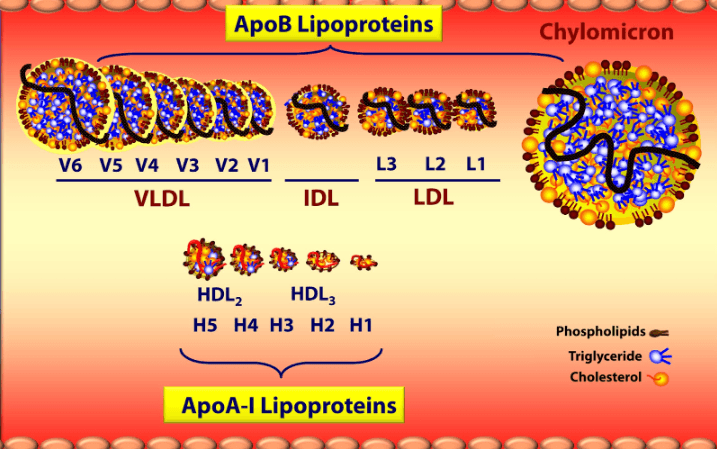
Figure 1. Two families of lipoproteins are defined by their surface protein: apoB or apoA-I.
{end of show notes preview}
Would you like access to extensive show notes and references for this podcast (and more)?
Check out this post to see an example of what the substantial show notes look like. Become a member today to get access.